
What happens when the Pentagon stops planning for climate change
Welcome to our new newsletter! Plus: How Saudi-owned corporate farms are draining Arizona’s desert dry

Forwarded by a friend?
Sign-up for our twice-monthly newsletter here — no spam, just bi-weekly updates on our investigations
Welcome to our redesigned newsletter!
If you’ve been with us for a while, you’ll notice things look a little different.
This newsletter used to be a simple story alert. It was great for driving traffic to our latest investigations, but it didn’t leave much room for connection with our readers or for sharing what happens between those big stories.
So we’ve changed it up.
After some newsroom brainstorming, we decided to turn this into a true window into Floodlight. Roughly every two weeks, you’ll get updates straight from our reporters: what they’re digging into, what they’re seeing on the ground and how we uncover the forces stalling climate action.
We’d love to know what you think as we try this new format out. You can vote below or just hit reply to share your thoughts — I read every message.
In today’s edition we highlight Floodlight reporter Ames Alexander’s latest story on how the Pentagon is retreating from its climate fight. We’ll also highlight:
- How Saudi-backed alfalfa farms are draining Arizona’s desert dry
- Image of the week
- Climate accountability news roundup
- Floodlight stories you might have missed
— Rosie Gillies, director of audience
Our latest: Pentagon retreats from climate fight even as heat and storms slam troops

Across the U.S. armed forces, climate change is already reshaping how troops can do their jobs. Training grinds to a halt on days when extreme heat makes it unsafe to work. Hurricanes have wiped out billions of dollars’ worth of infrastructure. And in recent years, the number of service members suffering from heat exhaustion has jumped 52%.
For decades, the U.S. military recognized these threats for what they were: national security risks. It hardened bases against flooding, built solar arrays to provide backup power and even developed hybrid combat vehicles to reduce deadly fuel convoys.
But that’s now changing.
Today in Floodlight and The Guardian, I look into how the Pentagon is retreating from its own climate preparedness plans — and what that means for the people on the front lines.
Under Defense Secretary Pete Hegseth, the Pentagon has slashed climate research, canceled 91 studies, and removed adaptation plans from public view. “The @DeptofDefense does not do climate change crap,” Hegseth posted earlier this year. His department’s 2026 budget proposal calls for cutting $1.6 billion in what it labels “wasteful” climate spending. Among the targeted programs: a $6 million Navy program to decarbonize ship emissions.
One of the canceled grants would have helped the Pentagon study how rising seas and extreme weather could fuel instability in the Philippines, Guam and Japan — regions critical to U.S. strategy in the Indo-Pacific.
Meanwhile, key military climate resources have vanished. Adaptation plans have disappeared from public sites, and the Pentagon’s climate resilience portal — described by former officials as a vital hub for assessing risks to bases and infrastructure — has been shut down.
Experts I spoke to warn these rollbacks could leave the military dangerously exposed as the planet heats. “It puts our troops at risk,” said Erin Sikorsky of the Center for Climate and Security.
“We’re going to be less prepared if our troops are deployed somewhere where it’s incredibly hot and their equipment doesn’t work right, or if they themselves can’t physically operate … That’s malpractice, I think.”
— Ames Alexander, investigative reporter
Partner Story: Saudi-owned corporate farms are draining Arizona’s desert dry
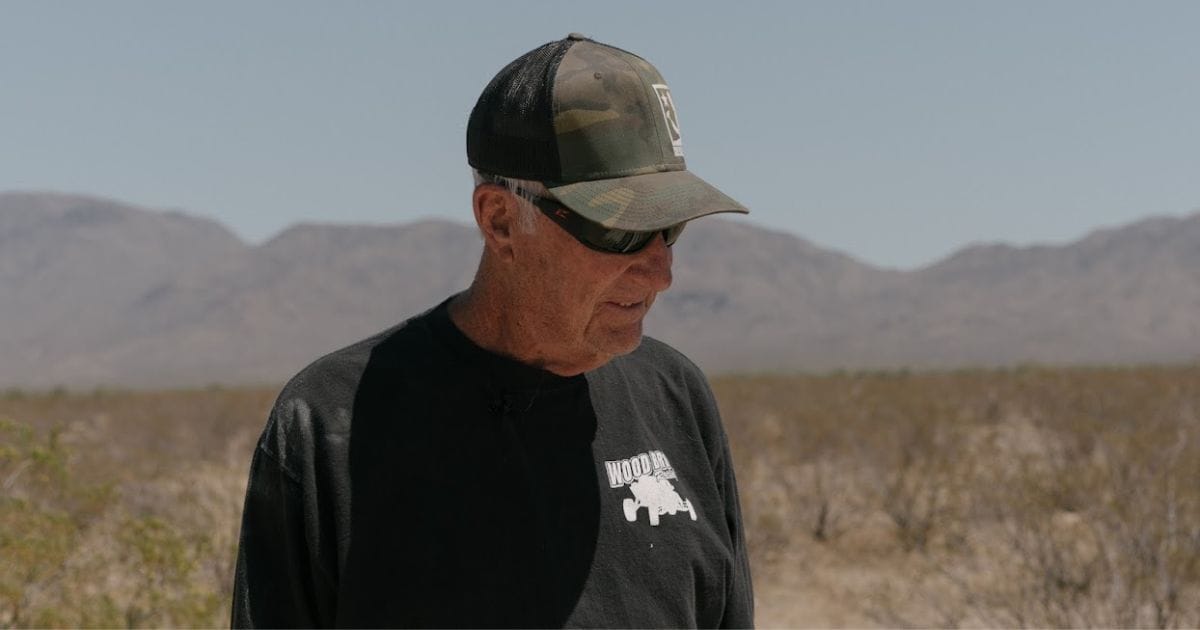
Floodlight occasionally republishes investigations from trusted newsrooms that align with our mission to expose the forces stalling climate action. This story, by Nina B. Elkadi, originally appeared in Sentient Media.
In Arizona’s La Paz County, residents are watching their wells run dry as Saudi-owned and corporate-backed farms pump the desert’s ancient aquifers to exhaustion. Fondomonte LLC, a subsidiary of Saudi dairy giant Almarai, used more than 30,000 acre-feet of groundwater last year — 81% of all water extracted from the local basin — to grow alfalfa shipped overseas to feed cattle. With almost no groundwater regulation across most of the state, homeowners are spending six figures drilling new wells while water-resource “hedge funds” buy up land for profit. “Once we lose it,” one resident says, “it’s not going to be replaced.”
Image of the week
What charts, graphics and photographs are revealing about climate change
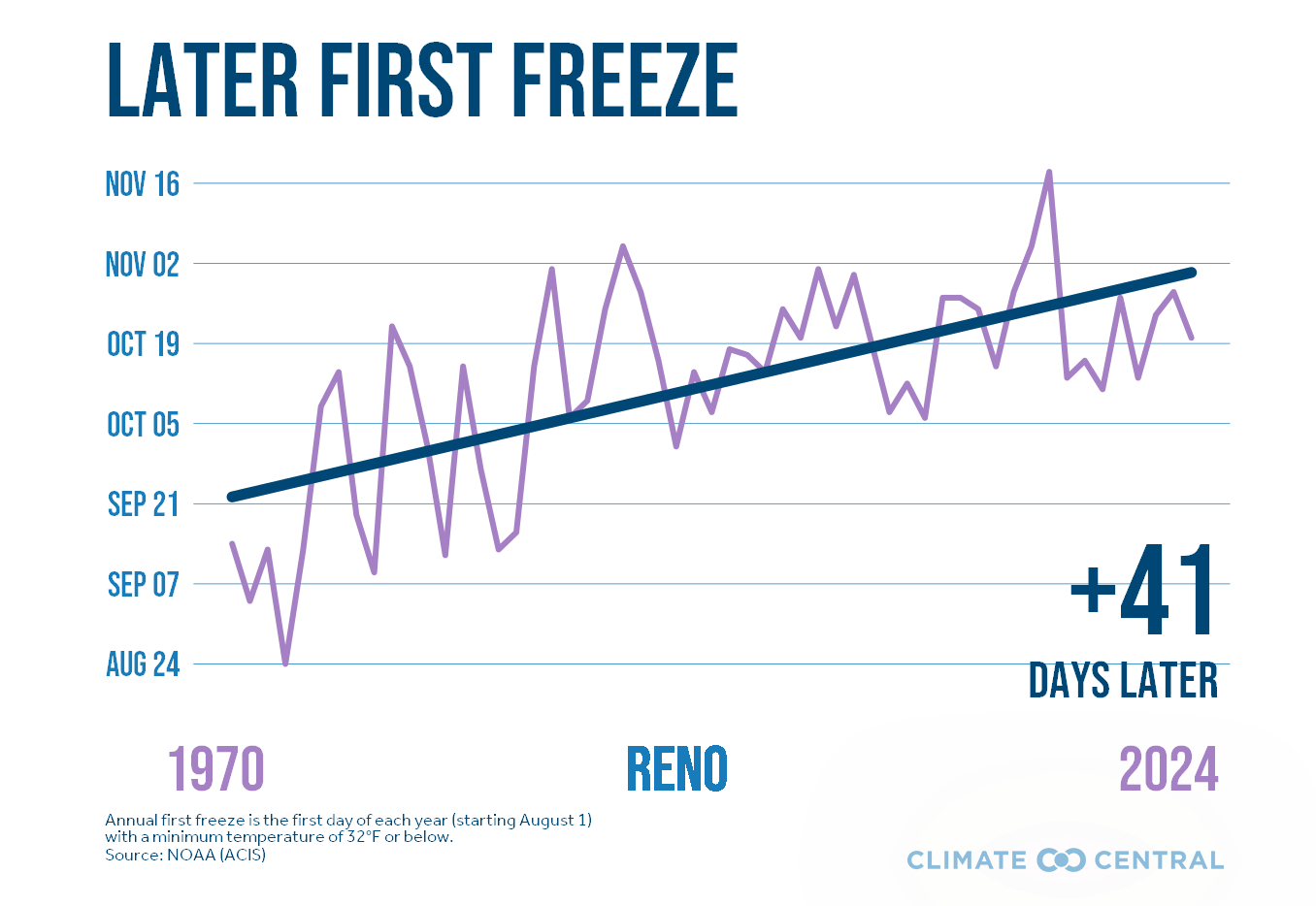
Climate Central’s new analysis shows just how much later the first fall freeze is arriving across the U.S. Reno, Nevada, tops the list, with its first freeze coming 41 days later on average compared to 1970. That’s nearly six extra weeks of mild nights before temperatures finally dip below freezing.
The longer warmth means a lengthened allergy season, more time for pests to linger and delayed cues for plants and wildlife that rely on cooler temperatures to rest or migrate. To see how the first fall freeze for your community has changed, check out this Climate Central tool.
Climate accountability news roundup
What just happened, and why it matters
Fossil fuel insiders dominate key federal posts More than 40 Trump appointees have direct financial or professional ties to oil, gas and coal companies, according to a new report from Public Citizen and the Revolving Door Project. The list includes senior officials at the U.S. Environmental Protection Agency, the departments of Energy and Interior and the White House itself. | Read more in The Guardian
Trump’s $8 million Helene fundraiser lacks transparency After Hurricane Helene, Donald Trump’s campaign raised nearly $8 million through GoFundMe, promising relief for storm survivors. But a Grist investigation found that most of the money went to faith-based nonprofits with close political ties to Trump and other Republican figures. Only one organization offered a clear accounting of how funds were spent, while others provided vague or no details at all. | Read more in Grist
Duke Energy retreats from renewables after state repeals climate goal After North Carolina lawmakers scrapped Duke Energy’s 2030 carbon-cutting mandate, the utility has proposed a sweeping pivot away from clean energy. Its new plan would halve wind and solar growth, delay nuclear projects into the late 2030s, and extend the life of aging coal plants while adding nearly 10 gigawatts of new gas units by 2035. Duke says rising electricity demand from data centers justifies the shift, but advocates warn it could raise costs and derail the state’s net-zero target. | Read more in Canary Media
Catch up with our latest
Floodlight stories you might have missed
 Terry L. Jones/Floodlight
 Ames Alexander/Floodlight
 Ames Alexander/Floodlight
 Terry L. Jones/Floodlight
 Ames Alexander/Floodlight
Rosie is Floodlight's director of audience and development. She was previously the audience editor at Bolts, and oversaw audience and web projects as digital director of Boston Review.